
Electric vehicles
Switching to an electric vehicle can help you save money and reduce your carbon footprint
Solar panels can lower your energy bills, increase your property value, and let you do your bit for the environment.

This guide can help you understand how solar panels work, how much they cost, and the money they could save you.
A typical solar panel contains 60 or 72 photovoltaic (PV) cells. These cells are usually made from silicon, which is an excellent semi-conducting material. When sunlight hits a solar panel, individual PV cells absorb solar energy and react by creating an electrical charge.
When the sun shines more strongly, PV cells absorb more light and generate more energy. The solar inverter turns this energy into electricity that can power your home.
Although direct sunlight is best, solar panels are able to generate energy for your home on cloudy days as the panels absorb energy from the solar wavelengths that pass through clouds.
Rain can actually help your solar panels work, as the water can wash away dirt and debris that could otherwise limit your solar panel’s ability to absorb sunlight.
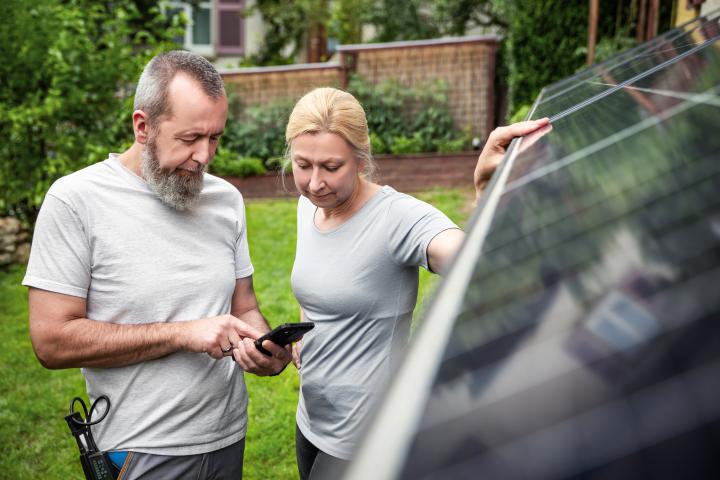
When your solar panels generate energy, your home relies less on the grid for energy. This means you can power appliances like your fridge using solar energy and save money on your bills.
You can earn money by selling extra solar energy to the grid. Learn more about the Smart Export Guarantee (SEG) scheme and how you can get paid for generating electricity.
A typical home solar panel system has the potential to save about 1 tonne of carbon per year, depending on where you live. This is equivalent to the carbon produced by driving 3,600 miles, or 100 trips from Preston to Manchester.
Our friendly experts are here to help. You can speak to them on the phone Monday to Friday, 9am-5pm for straightforward advice.
You can use Energy Saving Trust’s solar panel calculator to better understand if solar panels are a good fit for your home. This tool uses your property details to explain:
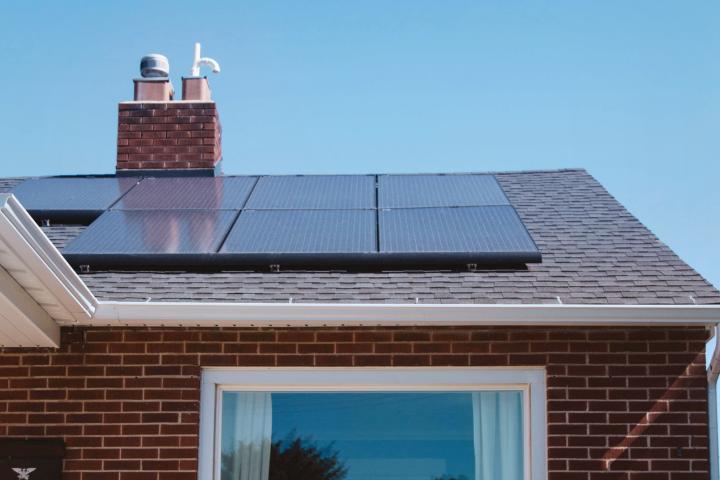
The position of your roof is also important to consider. The amount of shade and space, and the direction it faces, all impact how much solar energy your panels could generate.
The amount of money you could save per year with a solar panel system depends on:
| Time spent at home | Home all day | Home all morning | Home in afternoon | Out until 4pm | Out until 6pm |
| Annual savings | £580 | £540 | £530 | £480 | £470 |
*Data provided by Energy Saving Trust: Savings are indicative for a four-bedroom detached property in the UK, based on fuel prices as of July 2025 (GB, gas-heated) and November 2025 (NI, oil-heated). Find out more about how we made these calculations.
As of June 2026, there are no dedicated solar panel grants from the UK government. There may be funding available through other government schemes.
Our advisors can help you check if your local council or supplier are participating in the Energy Company Obligation Scheme.
The Government is expected to offer fully funded support to install solar panels for low-income households through the Warm Homes Plan. The scheme will also offer low-interest and zero-interest loans that are not tied to household income.
Our friendly experts can help you identify the funding available in your area.
The average cost of installing solar panels in the UK is around £6,100*, but the actual cost of installing solar in your home will depend on a few factors:
| Time spent at home | Home all day | Home all morning | Home in afternoon | Out until 4pm | Out until 6pm |
| Annual savings | £580 | £540 | £530 | £480 | £470 |
Solar panel systems don’t need a lot of maintenance, but regular upkeep will keep them working well for their full lifespan.
Yes, it’s best to clean solar panels every 12 to 18 months to stop dust or dirt from reducing the amount of sunlight that hits your solar panels.

Our expert advisors can deliver a free ‘Solar Made Simple’ session in your workplace or community.
These sessions are designed to help your community understand the benefits, costs and practicalities of solar energy with clear and impartial guidance.

Ready to take the next step towards your low carbon future? We provide free advice on low carbon technologies to help you make the best decision for your home.